
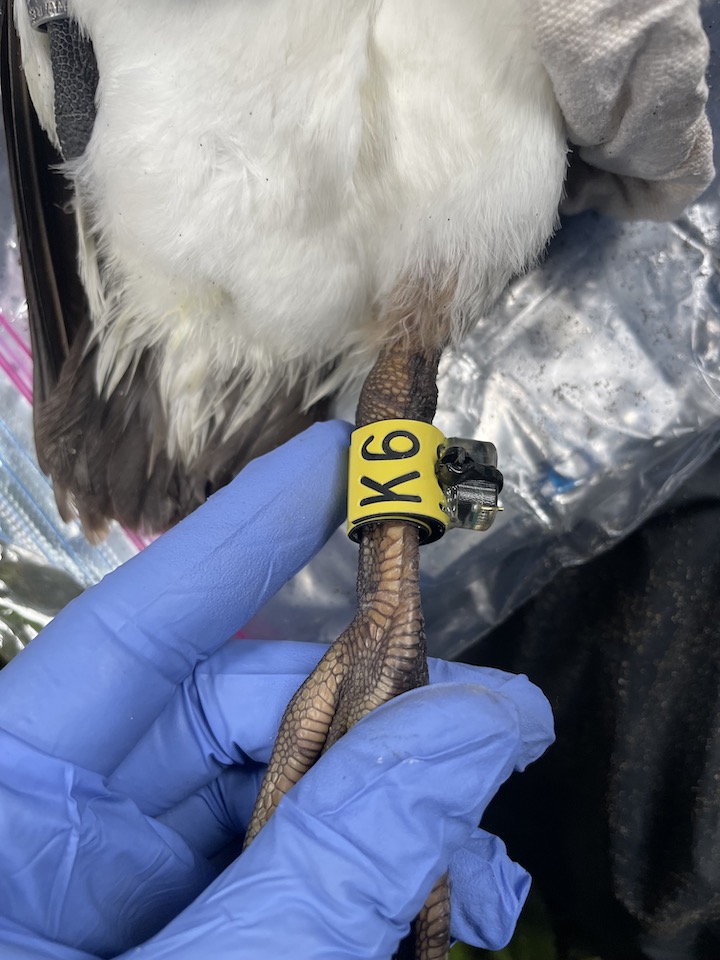
Julia Matteucci, Trish Pence, and Kristen Gorman returned to St. Paul this summer to continue their work on seabird non-breeding movement and habitat selection. The team is using geolocator tags to collect data on where adult Black-legged Kittiwakes and Thick-billed Murres spend the fall, winter, and spring months while they are away from the colony and out at sea. Blood and feather samples are also being collected from captured birds to test for mercury and stable isotopes (naturally occurring forms of elements that give us insight into food web interactions).
2025 Field Season
We deployed a total of 33 geolocator (GLS) tags on kittiwakes during the summers of 2023 and 2024. During Summer 2025, we retrieved 10 GLS that were deployed in 2024 and 3 GLS that were deployed in 2023, bringing our total number of retrieved tags to 23 (69% recovery rate). In addition, we observed an additional 7 tagged birds (90% return rate of birds to the colony), but were unable to capture these individuals.
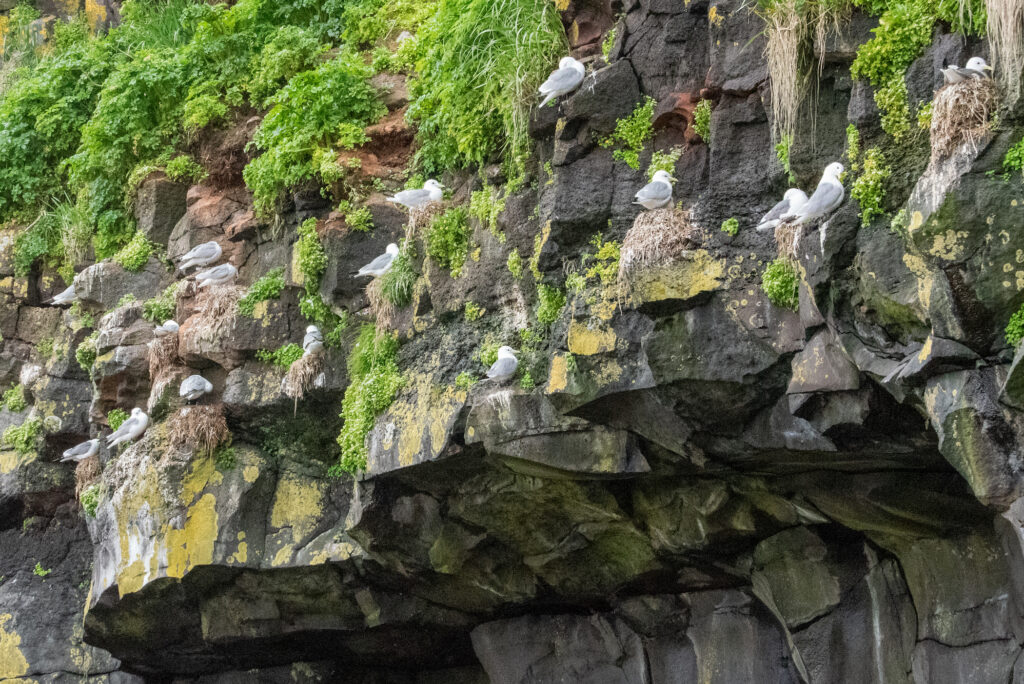
Kittiwakes on their nests
Six of the tagged kittiwakes at the Ridgewall colony did not nest this year which made it impossible for us to catch them. When kittiwakes successfully breed, they are less likely to leave their nest due to the need to incubate their egg and protect their chick from predators and poor weather. This makes it easier for us to capture them on the nest. If their nest fails (they lose their egg or chick), or they choose to skip breeding one year (common in seabirds especially when foraging conditions are poor) they have less of an incentive to remain at their nest. They often remain at the colony, but are more likely to fly off the cliff when startled, ultimately making it impossible for us to catch them with the equipment we have.
2024 marked our first season where we deployed GLS tags on Thick-billed Murres! We deployed a total of 13 GLS on murres in 2024 and successfully retrieved 9 of those tags in 2025 (69% recovery rate). We observed one additional tagged murre (76% return rate of birds to the colony), but were unable to capture it. We deployed an additional 14 GLS that we will attempt to retrieve in Summer 2026.
On another exciting note: many of the murres on St. Paul successfully nested in 2025! We observed about 30 murres incubating across two of our colonies, including some of our GLS tagged birds. While these numbers are still a low compared to historical data, it was a great improvement over the last two years where murres totally failed to breed. We were fortunate to observe several murres successfully hatch chicks as well! It was amazing to watch the chicks grow and observe the brooding behavior of the parents. We even got to see some parents return to the colony from a foraging trip with a fish to feed the chick! It was so cool to observe the murres throughout the whole breeding process.
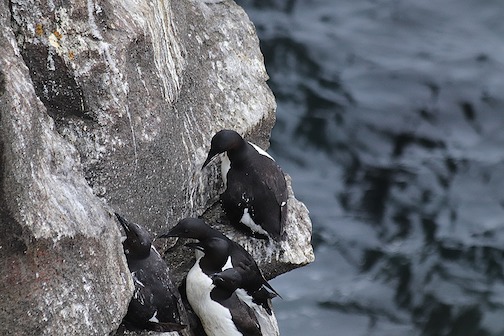
Breeding Thick-billed Murres
Most of the GLS tags (both kittiwake and murre) collected a full year’s worth of data, however some of the tags failed to collect data due to technical malfunction or saltwater damaging the battery. Despite these tag failures, we had great success with both kittiwake and murre tag recovery this season and we’re looking forward to 2026.
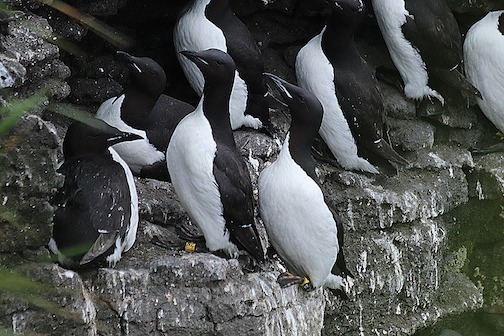
Thick-billed murres on their breeding ledge. Yellow leg bands are visible on two of these murres. The geolocator loggers are attached to these yellow bands using small zip ties.
2026 Field Season Plans
Next summer we are returning to St. Paul to collect the remaining GLS tags from both kittiwakes and murres. Blood and feather samples will be collected from these birds to continue our mercury and stable isotope analyses.
Many thanks to our funders for making this research possible
This study is funded by the USFWS Tribal Wildlife Grant program, the UA Faculty Initiative Fund, the Oil Spill Recovery Institute, and the Rasmuson Fisheries Research Center Graduate Student Fellowship (through the College of Fisheries and Ocean Sciences at UAF).